
1. The Mid‑1990s: A Strong Middle‑Class Anchor
In the mid‑1990s, manufacturing jobs were widely considered premium blue‑collar roles.
Average hourly earnings hovered around $11–$13/hour, roughly $22–$26/hour in today’s dollars after inflation adjustment.
Manufacturing wages were 10–20% higher than service‑sector jobs.
Union density was still strong, especially in automotive, steel, and machinery.
Key dynamic: Manufacturing was still heavily domestic, and global competition—especially from China—had not yet reached full force.
2. 2000–2010: Globalization and Wage Stagnation
This decade marks the most significant structural shift.
Major forces:
China’s entry into the WTO (2001)
Offshoring of labor‑intensive production
Rapid automation in high‑volume plants
Decline in union membership
Wage impact:
Nominal wages rose slightly, but inflation-adjusted wages stagnated or declined.
By 2010, real manufacturing wages were 5–10% lower than in 1995.
Many mid‑skill roles disappeared, replaced by lower‑wage logistics or service jobs.
Key dynamic: The “China Shock” reduced bargaining power and compressed wage growth across the sector.
3. 2010–2020: Automation and Skill Polarization
Manufacturing rebounded in output but not in traditional employment.
Wage trends:
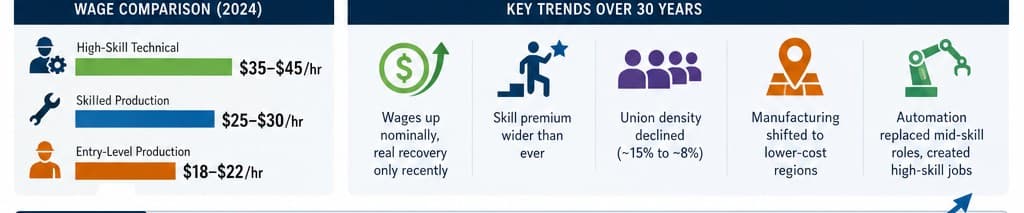
High‑skill roles (robotics technicians, CNC programmers, industrial engineers) saw strong wage growth, often reaching $30–45/hour.
Traditional assembly and machine‑operator roles grew slowly, averaging $18–22/hour by 2020.
Overall wage growth improved, but inequality within manufacturing widened.
Structural shift:
Plants became more automated and lean.
Employers prioritized technical certifications over tenure.
Non‑union plants expanded, especially in the South.
Key dynamic: Manufacturing became a bifurcated sector—high‑skill workers thrived, while legacy roles plateaued.
4. 2020–2024: Pandemic Shock and Wage Acceleration
COVID‑19 disrupted supply chains and created labor shortages, pushing wages upward.
Wage impact:
Average hourly manufacturing wage reached $25–28/hour by 2024.
Some subsectors—semiconductors, aerospace, advanced automotive—offered $30–35/hour for skilled roles.
Employers raised wages to compete with logistics giants like Amazon and UPS.
Additional drivers:
Federal incentives for domestic manufacturing (CHIPS Act, IRA).
Reshoring initiatives in electronics, EVs, and critical materials.
Tight labor markets in industrial regions.
Key dynamic: For the first time in decades, manufacturing wages grew faster than inflation.
5. 2024–2026: The New Industrial Era
The current landscape reflects a manufacturing sector undergoing reinvestment and modernization.
Wage characteristics today:
National average manufacturing wage: ~$29/hour
High‑skill technical roles: $35–45/hour
Entry‑level production roles: $18–22/hour, depending on region
Unionized automotive roles (Big Three): $32–40/hour, plus bonuses
Regional differences:
Midwest: Strong legacy wages, especially in automotive and machinery
South: Rapid growth in EV and battery plants, but lower starting wages
West Coast: Higher wages in aerospace and semiconductor fabrication
Key dynamic: Manufacturing wages are rising again, but the gap between high‑skill and low‑skill roles continues to widen.
6. The 30‑Year Arc: What Really Changed?
1. Wage Growth vs. Inflation
Nominal wages increased significantly, but real wages only recently recovered from decades of stagnation.
2. Skill Premium
Technical skills now command a substantial wage premium—manufacturing is no longer a uniform wage sector.
3. Union Decline
Union membership fell from ~15% in the 1990s to ~8% today, reducing wage bargaining power in many regions.
4. Geographic Shift
Manufacturing moved from high‑wage northern states to lower‑wage southern states, moderating national averages.
5. Automation
Robotics and digital manufacturing eliminated many mid‑skill roles while creating fewer but higher‑paid technical jobs.
7. What This Means for Workers and Employers
For workers:
Technical upskilling (PLC, robotics, CNC, mechatronics) is the most reliable path to higher wages.
Certifications matter more than ever—NIMS, AWS welding, Siemens Mechatronics, FANUC robotics.
For employers:
Wage competition is rising, especially for skilled maintenance technicians.
Retention now depends on career pathways, not just hourly pay.
Plants must balance automation investment with workforce development.
8. The Bottom Line
Over 30 years, U.S. manufacturing wages have transformed from stable middle‑class anchors to a polarized, skill‑driven wage ecosystem.
The sector is stronger, more advanced, and better paid than it was a decade ago—but the benefits increasingly favor workers with technical expertise.